
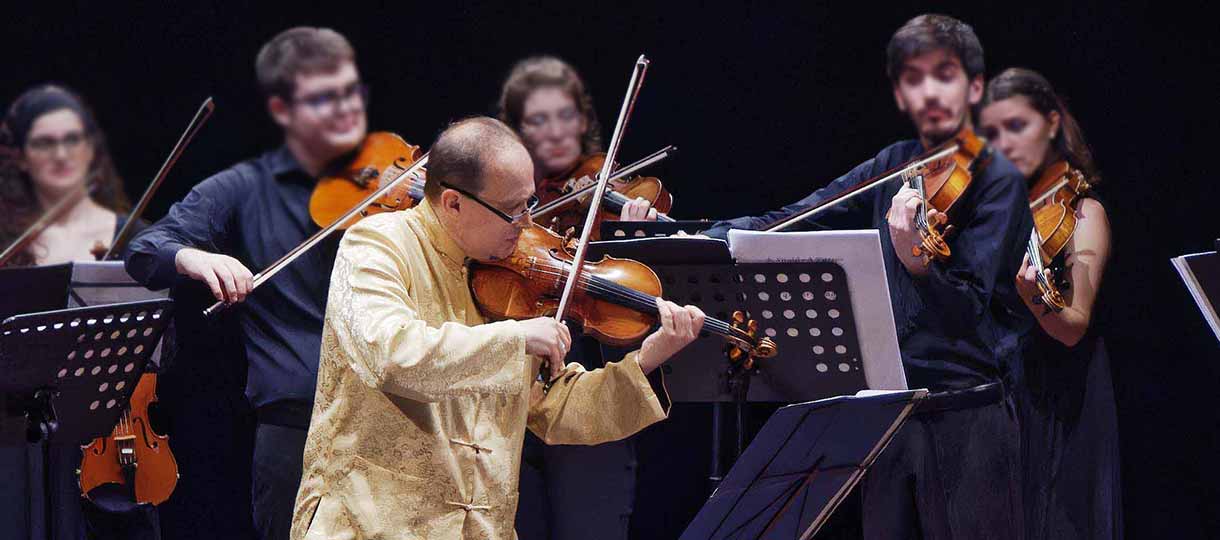
Winner of multiple awards, since 1992 Francesco Manara has been first violin of the Teatro alla Scala Orchestra and of the Orchestra Filarmonica della Scala. He is the founder of the Trio Johannes, and since 2001 has been the first violin of the Quartetto d’Archi della Scala. As concertmaster he has performed under the greatest conductors of our time and has played with some of the most prestigious orchestras in the world. As well as teaching at the Accademia della Scala school, he has been a member of the panel of judges for international competitions.
At the Accademia in Pinerolo, Francesco Manara has taught an advanced course in violin since 2024 and has conducted the school’s chamber music orchestra, Orchestra da Camera Accademia, in three concerts. We interviewed him in the context of our project, A Career in Music, to ask him what suggestions and practical advice he would give to our students, who are destined to become the future generation of professionals.
What were the key experiences that marked your development and training as a musician? At what time of your life did they take place? Why were they significant?
I believe that your professional life is inseparably intertwined with your life as a whole. Like my development as a human being, my growth as an artist has been marked by several fundamental encounters. I will mention them in no particular order, apart from the first one, which was not really an encounter but a gift life gave to me. It was my father who introduced me to music, even though he was not a musician but a lawyer. He had a great passion for and a deep knowledge of classical music, had a wonderful collection of records and spent practically every evening listening to music. I soon began to keep him company and, thanks to his expert explanations, I gained a deep understanding of music from a very early age. Here’s just one example. In second grade, our teacher asked us to write a composition on any topic we chose. Not knowing what to write about, I wrote out, word for word, the entire first act of Giuseppe Verdi’s Macbeth (libretto by Francesco Maria Piave); I knew it by heart at the age of seven! The following year, I was listening to Tristan und Isolde while reading the libretto with Italian and German texts side by side (even though I knew no German), and could already recognise all the various leitmotifs. When I was 10, I decided to take up the violin. This was because my father’s vast record collection also included Bach’s sonatas and partitas performed by Szeryng, which had become part of the soundtrack of my childhood and were the reason why I fall in love with the sound of the violin. At that time I already knew most of the repertoire for symphony, chamber and opera music, even though I could not yet read music.
In addition to listening to music sitting on the sofa with my father, I soon began going to hear performances with him, together with my uncle (another fundamental encounter). I had a season ticket for the Turin Rai Orchestra concerts and later for the Unione Musicale season; I also often went to see opera at the Teatro Regio in Turin and occasionally even went to see operas at La Scala. All this allowed me to follow the
opposite path to the usual one where, in a best-case scenario obviously, you first acquire musical skills on an instrument and then begin to learn about the music repertoire,.
Naturally, I then had a lot to catch up with as regards technique, since I had started learning the violin relatively late, but I made up for this by putting the violin at the heart of my life. I was later fortunate enough to meet other key figures, my first teachers: Professor Quaglino and then, shortly afterwards, her nephew, the great Maestro Massimo Marin, whom I was lucky enough to study with for all the years of my studies at the Conservatory in Turin. Both these teachers helped to intensify my passion for the violin and music, and taught me to adopt an approach to my studies that was extremely serious, but also very creative. Unlike almost all of his colleagues, Maestro Marin was not the possessive type of teacher. He encouraged me to meet other great teachers while I was still studying, well before I graduated, and so I had the opportunity to begin studying with violinists and teachers of the calibre of Franco Gulli, Ruggero Ricci and Stephan Gheorghiu. All this was also made possible thanks to another encounter, with Francesca Camerana and the De Sono association, whose invaluable help enabled me to progress as a musician. Later, while I was still working with Camerana, we decided that Herman Krebbers would be an excellent guide for me immediately after graduatiing. I learnt so much from him: he provided the perfect combination of instruction about technique and about music with practical examples that left no room for doubt of any kind.
He also gave me a model for the kind of career that I eventually followed: for many years he was the First violin with the Concertgebouw in Amsterdam, as well as performing as a soloist, in chamber music ensembles, and becoming a world-famous teacher. Undoubtedly, from when I became a member of the La Scala Orchestra, way back in 1992, I had many, many very important encounters; first of all, I came into contact with Riccardo Muti, who “adopted” me and made a great contribution to my growth as an artist.
Let me also go back a little to make it clear that my family (as well as my father, there was my mother, my grandmother, and my brother) played a fundamental role in supporting me in my dreams of becoming a musician in the future. Another gift that life gave me was meeting the person who would become my wife. I had to play a concert in faraway Colombia, which initially was the source of quite a bit of anxiety: vaccines were needed, and there was the fear of being robbed or kidnapped (it was a time of maximum tension between the armed militia of FARC and the paramilitary army). But as it happened the only thing I had “stolen” was my heart. My wife teaches cello to children using the Suzuki method, and as well as supporting me, putting up with me, and being my beloved life companion, she is also the mother of my two wonderful children, the most precious gifts life has ever brought me.
Can you describe one or two turning points in your career? What impact did they have on your career? Why were they important?
Undoubtedly, the most decisive moments in my career were when I obtained the position as First violin soloist at La Scala and several awards I won in international competitions for solo violin (above all, First prize at the Geneva International Music Competition: these really marked the beginning of my career. I could also mention the many concerts I performed in, as a soloist, in chamber music ensembles, or playing as concertmaster in orchestras under world famous conductors: so many unforgettable concerts. However, precisely because I believe that your career and your life path are inextricably intertwined, what I consider even more important was the moment when I realised that performing music in order to improve people’s lives, which means bringing music to even the smallest venues, with few resources, or to marginalised people, could be healthier for the soul than continuing to chase after success, fame and money. I realised this as I progressed in my career, as I matured and, of course, as I had the opportunity to participate in the Vie dell’Amicizia concerts organised by the Ravenna Festival with the Filarmonica della Scala orchestra, especially when we went to Sarajevo, playing alongside musicians who had recently lived through the horrors of war. I was also lucky enough to be invited to teach in Venezuela in the famous system invented and organised by Abreu: the aim was to take children off the streets and put a musical instrument in their hands (instead of a weapon), thus giving them the chance to lead a different life. The core of this experience was working closely together with other musicians or enlightened people who had generous hearts, though naturally the origins of these convictions of mine could also be found in the encounters and “gifts” I mentioned earlier and in the friends I have associated with.
Often our mistakes teach us important lessons. If you could go back in time in your career what would you do differently?
We often ask ourselves, ‘What would have happened if…’, but apart from the fact that ‘ifs and buts don’t write history’, I am convinced that if things have turned out the way they have, it is because that was always the right decision to make.
Certainly I have made some basic, stupid mistakes: for example, at a motorway service station in Germany, I accidentally left behind an envelope containing the entire fee for a concert I had just performed in (very well paid!). Then again, at another motorway service station, this time in Italy, I left behind my last violin (an extremely valuable Guadagnini); in this case, however, I was lucky enough to find it when I went back a few hours later…
Along a musician’s career path there are always many important decisions to be made and these often depend on and result from the opportunities that are offered to them. What helped you to stay focused and not to lose sight of your goals?
I believe that in order not to lose your focus, every day you need to train yourself to improve the connection, and encourage the cooperation, between your head and your heart. The magic word is balance, which applies both to life and music, of course…
Apart from studying with great passion and dedication, what advice would you give to young musicians who are starting out on a career in music?
To young people who are perfecting their skills, I can recommend some rules of conduct that I have adopted and assimilated during my long career. I will try to list them as they come to mind:
- Try to be humble. Instead of judging others harshly, try to be severe on yourself, aiming for continuous improvement and avoiding any waste of energy. Your criticism should always be constructive and never negative. Do not miss any opportunity to learn from everyone: from talented musicians and instrumentalists, you learn what you should do; from the less talented, you learn what NOT to do. If you are to inprove, it is absolutely necessary and helpful to compare yourself with others. Our worst enemies are always ourselves. The monsters that we all inevitably have within us are the result of our negative experiences, fantasies, dissatisfactions and frustrations.
- Do not consider the violin as a vehicle for demonstrating your great talent, but rather as a means to share the beauty of music with others. And always try to serve the great composers as well as possible: in comparison to them, all performers like us are infinitely small.
- Never approach competitions and auditions with a competitive spirit: rather, try to compete with yourself, striving to play better each time than the time before. When you encounter failure, always try to seize the opportunity to come back again stronger and more motivated than before. “From the fall comes the rise”, wrote Victor Hugo. I myself have learned more from failures and criticism than from praise and victories.
- Never consider yourself to have arrived, even after the most brilliant successes. Life is a unique opportunity to grow and learn, right up to the very last day if possible.
- Performance anxiety is unavoidable. Try to manage it by turning it into positive emotion. Life is made up of emotions, so we must make friends with them, be grateful for them and utilise them to make even more music to give to those who listen to us.
- Try to make good use of all the technological tools available to you, the mobile phone above all. Use it because it’s useful, because it makes you easy to contact, and because you are curious to learn, and not just about music (listen to audiobooks, watch lectures on history and philosophy, use it for anything that can help your personal growth).
- Use YouTube to learn more about music and interpretations by great musicians: it is unbelievable, but true, that 90% of the young violinists I put this question to have never listened to (and in some cases never even heard of) Arthur Grumiaux, Christian Ferras or Michael Rabin, or not even Milstein or Kogan. At best, they will have clicked on a few performances by some violinists of the present day!
- Listen to music played on other instruments: symphonies, chamber music, and opera. Or why not listen to other, different genres too, always trying, as far as possible, to choose music of quality, which is not necessarily (in fact, almost never) commercial.
- Use Wikipedia or Flaminio Online to find out about the compositions you are working on and about those you would like to listen to or explore in greater depth.
- I do not advise you to use your mobile phone or computer as a way of showing off or as an extension of your ego…. I’m not saying you should take me as a model: I am not on Facebook or Instagram; I barely tolerate emails and WhatsApp, which I use only so that I can be easily contacted and for work messages (and of course, at this point, I also use it with family and friends). It can be a great communication tool, but also an incredible waste of time, as well as being another useless drain on your energy, especially when, from behind a keyboard, you start to lose respect for others. One of the people I admire most in the world, my brother, has actually chosen not to own a mobile phone. He only uses a computer for work, but he always carries with him at least one book to read.
- Realise that silence and your own company are excellent companions. Often, thanks to a little healthy solitude, you can start to think, create, and, why not, even have fun. Or you can find time to take care of your body so you can be healthier, as well as, naturally, to study in order to improve your technique and expand your repertoire. I, for example, love taking long walks in the countryside and love foraging for mushrooms.
- The company of animals can also be amazing. I often consider my cat to be my teacher: just his presence is enough to improve my mood even on the worst of days, and the example he gives of doing only the things he likes often guides me towards making the right decision…
There is a lot of other advice I could give, and everyone must find the right advice to follow for themselves, as long as that advice is in harmony with respect for themselves and others. One last piece of advice, that we should never take for granted: never forget to be grateful for life. We are fortunate to have the chance to live in contact with Beauty every day and to have the opportunity to work at creating music, which is the most wonderful job in the world. And even if we can’t make a living from music alone, we can always count on the rich inner life it brings us, a gift that will enable us to live more happily and, thus, always strive to be better people…
A career in music: ALL THE INTERVIEWS >>

