
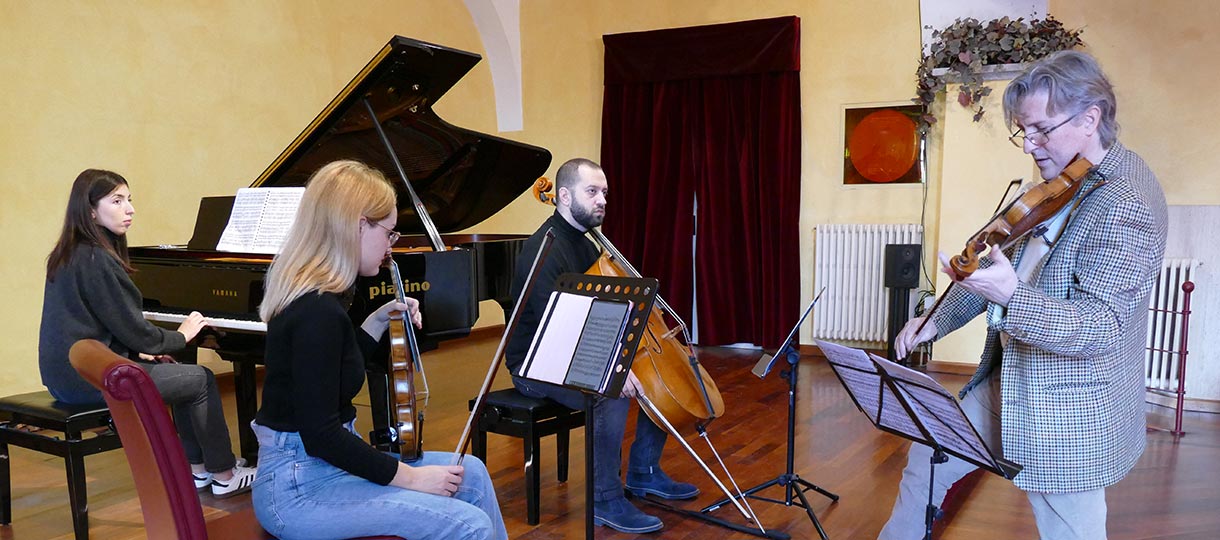
Winners of the Premio Abbiati for best chamber music ensemble, Trio di Parma is one of the most prestigious and long-lived ensembles in the world of Italian chamber music. For more than thirty years, pianist Alberto Miodini has been performing with Ivan Rabaglia, playing his precious violin (a ‘Giuseppe Baldantoni’ built in Ancona in 1850), and with cellist Enrico Bronzi, who also plays a unique instrument (a ‘Vincenzo Panormo’ made in London in 1775). This renowned Trio have appeared in the most important concert halls, for major music organisations in Italy and abroad, winning the most prestigious awards. Their teaching commitments, which have been constant, have included courses at Santa Cecilia, the Mozarteum and at the Conservatorio di Parma.
Trio di Parma have been teaching at the Accademia di Musica for several years, both in the Postgraduate Specialist Course in Piano, and in a very popular Advanced Course in Chamber Music. Individually, all three members hold summer masterclasses in Bardonecchia for Musica d’Estate. We interviewed them in the context of our project, A Career in Music, to ask them what suggestions and practical advice he would give to our students, who are destined to become the future generation of professionals.
What were the key experiences that marked your development and training as a musician? At what time of your life did they take place? Why were they significant?
Alberto Miodini – I think i can speak also for my colleagues Ivan and Enrico, when I say that I was lucky enough to begin playing music with the lighthearted approach that was right for our young age. So, right from the start, we experienced music as pleasure: it was almost a game to us, though, as kids always do when playing games, we took it absolutely seriously. Later, the years we spent studying our instruments and music theory with the right teachers, until we were 20, were of course fundamental. As regards chamber music, I can never forget how important our contact with the Trio di Trieste was: after the years studying at the Conservatory, it was absolutely fundamental for us to discover role models who had such a strong ethical approach to music and such an intense sense of commitment. Apart from the specific lessons they taught us about interpretation and performance, the heart of our experience of studying with them was the dedication and humility that these Maestros communicated to their students.
Can you describe one or two turning points in your career? What impact did they have on your career? Why were they important?
Enrico Bronzi – I find it difficult to talk in terms of career, because the path of a musician is so different from a normal working career: it’s more like a constant process of development. For this reason, I would choose all the moments that brought me a step closer to greater freedom as an artist or gave me a growing confidence in my own abilities. To this end, the awards won in competitions have been fundamental. Even though I don’t really like the idea of competitions as a measure of music, the experience of working with concentration that a competition demands of you and the increase of confidence resulting from your success are precious gifts for any musician who tortures themself with self doubts day after day.
Often our mistakes teach us important lessons. If you could go back in time in your career what would you do differently?
Ivan Rabaglia – If I could go back in time I would pay more attention to my professional profile on social media. I am only now realising that it can be a very effective way of presenting music events and concerts to a wider audience. However, there are some artistic directors of concert seasons who engage musicians based on the number of followers they have on Instagram: nothing could be more wrong and dangerous. The ability to perform a concerto of at least an hour in a medium- or large-sized concert hall, to an audience of 200 or 1,000, has absolutely nothing to do with being able to post 20 seconds of music on a computer.
Along a musician’s career path there are always many important decisions to be made and these often depend on and result from the opportunities that are offered to them. What helped you to stay focused and not to lose sight of your goals?
Enrico Bronzi – I think everyone has their own story. Perhaps for me the key idea that has guided me in my life as a musician is to do things gradually. In some ways I have zero envy for the enfants prodiges or other musicians who, when they are very young, suddenly find themselves catapulted into a world that is too vast and complicated for them. There are difficult choices to make, but if we do have the possibility to make independent choices that affect our future, we are very lucky.
Apart from studying with great passion and dedication, what advice would you give to young musicians who are starting out on a career in music?
Ivan Rabaglia – The first thing I would say is to take an intelligent approach to competitions. These are always the most important step forward on your career path, but you must be well prepared and have the necessary mature mindset. My second point is about Advanced courses: many young musicians today believe that following several courses at the same time will help them to store more information in the shortest time possible. I believe that the most valuable time is the time you spend trying to understand how to teach yourself and how to transform the lessons of your teachers into something that is truly your own.
A career in music: ALL THE INTERVIEWS >>

