
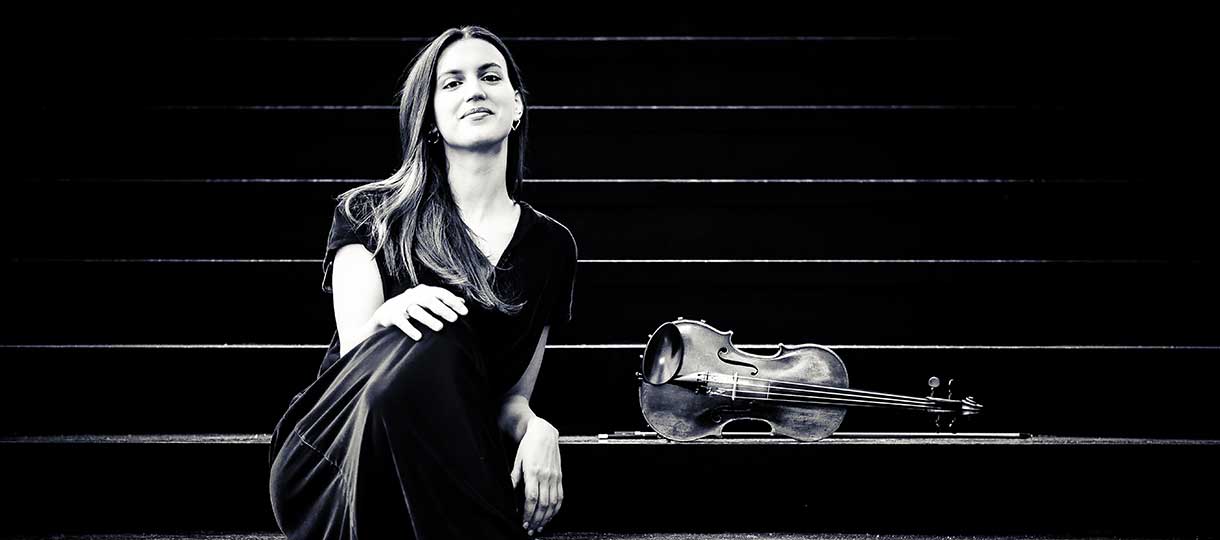
First violin in Quartetto Lyskamm and Concert Master for the Kammerakademie Postdam and Münchener Kammerorchester, Cecilia Ziano is considered one of the most brilliant musicians of the new generation. Her successful international career includes performances with prestigious orchestras like Berliner Philharmoniker and the Concertgebouw Orchestra. With Quartetto Lyskamm she has won many awards, including the Borletti-Buitoni Chamber Music Prize, and has performed in the major music festivals and concert halls throughout Europe.
At the Accademia di Musica, Cecilia Ziano teaches an advanced course in violin. We interviewed her in the context of our project, A Career in Music, to ask her what suggestions and practical advice she would give to our students, who are destined to become the future generation of professionals.
What were the key experiences that marked your development and training as a musician? At what time of your life did they take place? Why were they significant?
It was the experiences I had playing with other people: every experience that profoundly affected me and that led me to new insights and discovery happened in the context of playing together or chamber music. From Suzuki in Torino, to the courses held by Xenia Ensemble, to my first experiences playing in an orchestra or in a quartet. I believe that the musicians whom I met and who later taught me and inspired me were very focused on reading music, all music, as if it were chamber music. And I could not agree more.
Can you describe one or two turning points in your career? What impact did they have on your career? Why were they important?
So many things have happened to me! Certainly, one turning point was when I decided to join Quartetto Lyskamm so many years ago, in 2013. I am passionate about being a member of a quartet; it’s a life choice that becomes part of you. We share a life together and I owe so much to the quartet from every point of view. I would not be the musician I have become if I had never invested in this project. So it undoubtedly made a very definite change in my life. And then there was my first important orchestra role, which was with the Rotterdam Philharmonish Orkest. This was the beginning of my international career as Concert Master.
Often our mistakes teach us important lessons. If you could go back in time in your career what would you do differently?
As regards my career path I wouldn’t change a thing. I made some very difficult choices, such as deciding to go and study in Berlin, in a very, very competitive school that was diametrically opposed to my personal view of music. But even this turned out to be an excellent training ground and a very important step forwards. I had completed my high school diploma in Italy and had just graduated from the Conservatory; none of my peers had ever gone or had any intention of going to Berlin, so I had no experiences to refer to, and I never could have imagined that a music school could be so rigorous and so extremely demanding. But I was a romantic; this school taught me what it really meant to be a professional violinist. I took my future very seriously, and am ready to own even my mistakes. These mostly resulted from the great naivety and impulsiveness of youth, but there was nothing really tragic. You have to weigh up the costs against the benefits and so far the balance has been in my favour.
Along a musician’s career path there are always many important decisions to be made and these often depend on and result from the opportunities that are offered to them. What helped you to stay focused and not to lose sight of your goals?
I think it was the fact that my goal has always been to be a good musician and to become a better one, and not to aim for success, money or fame. So everything I have done sprang from my wish to progress, without ever losing sight of the things that I was really passionate about, the things that really inspire and uplift me in playing the violin. Not forgetting my enormous determination and discipline: even today, when I’m studying, I never neglect the smallest detail. This is how I have almost always managed to follow my instinctive attraction towards the things that felt right for me and that have given me so much satisfaction. I believe that if your motivation is not authentic, it is unlikely that you will ever have a real career or be truly respected.
Apart from studying with great passion and dedication, what advice would you give to young musicians who are starting out on a career in music?
Be courageous! I meet more and more young people who are petrified by the first difficulties they encounter. Too often they want everything, and right now. But music and studying need time, awareness, knowledge. Studying doesn’t mean locking yourself up in a room and repeating things obsessively. I advise my students to read, to be curious, to try and try again and not to be afraid of failure, or rather of what they consider failure, which is playing “the wrong note”. We are bedazzled by sterile perfection and ignore what it really means to study to become musicians of culture, pushing ourselves beyond our limits for, and in the name of, music. Harnoncourt said that real beauty is only ever achieved on the edge of a cliff, a quote that I have always found incredibly inspiring.

