
Enrico Dindo, who is one of the best-known cellists in Italy today, at the age of 32
won first prize in the Rostropovich Cello Competition in Paris, one of the most prestigious awards in the world. After this confirmation of his great talent, he began a career as a soloist, performing with the most famous orchestras in the world. He has taught at the Santa Cecilia Conservatoire for more than twenty years, and holds the Chair in Cello at the Conservatorio della Svizzera Italiana in Lugano. The cello he plays was made by Pietro Giacomo Rogeri (ex Piatti) in 1717, and is lent to him by the Fondazione Pro Canale foundation.
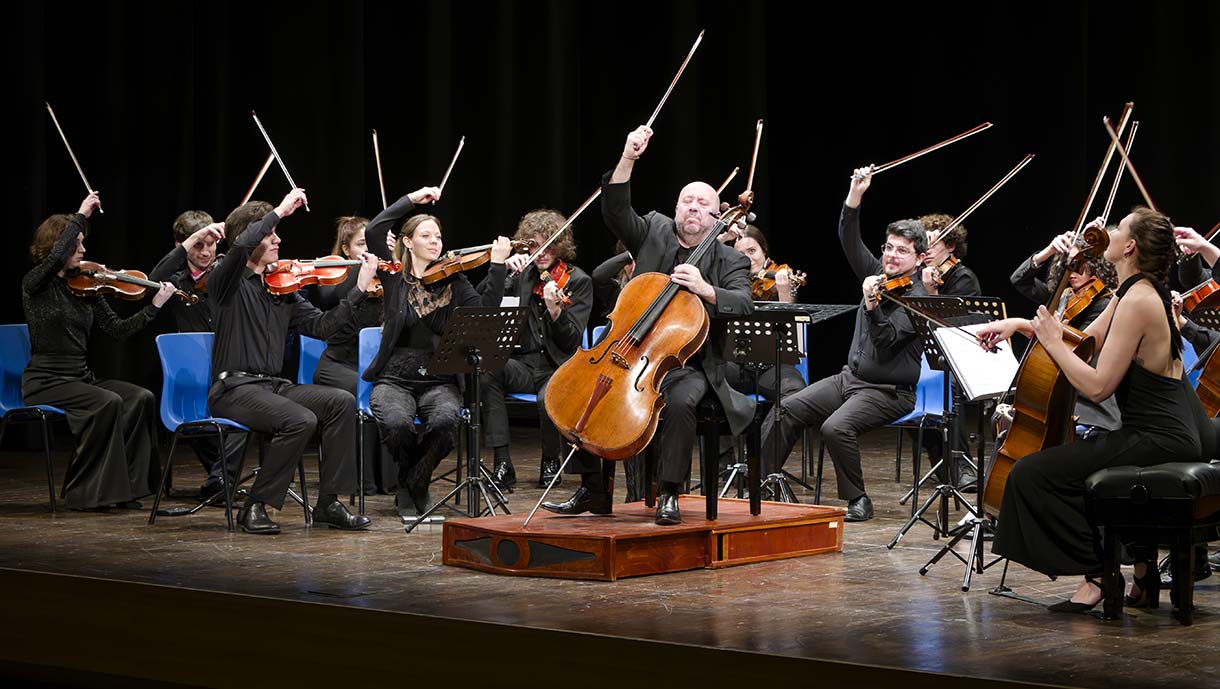
Enrico Dindo has taught masterclasses and performed in concerts for the Accademia for many years, has conducted the school’s chamber music orchestra, Orchestra da Camera Accademia, and now teaches the Light Course in Cello. We interviewed him in the context of our project, A Career in Music, to ask him what suggestions and practical advice he would give to our students, who are destined to become the future generation of professionals.
What were the key experiences that marked your development and training as a musician? At what time of your life did they take place? Why were they significant?
Every single experience, at any age, adds to the depth of your training as a musician. It’s up to you to recognise its value and significance and to benefit from it. Certainly, I had the good fortune to meet people who helped me a great deal in my early years of training. I’m thinking of the teacher who literally “initiated” me into playing the cello, Giuseppe Ferrari (first cello in the RAI Orchestra in Turin in the ’70s). And I could not forget Renzo Brancaleon, with whom I studied for 10 years at the Conservatorio, and who taught me the patience needed for study and repetition. Then there was Italo Nicola, whom, thanks to family friends, I had frequent contact with, and who gave me a lot of help with music and interpretation. But the turning point for me came with Antonio Janigro, who immediately made me aware of the depths upon depths that exist in the role and mission of an artist: he opened my mind and gave me courage and vital energy.
The 11 years I spent as first cello in the Orchestra della Scala were a magnificent training ground, of which I took full advantage. Every day I appreciated the great lessons in music to be learnt from the many conductors, singers and soloists in every instrument all working around me: each one left me with some valuable knowledge.
Can you describe one or two turning points in your career? What impact did they have on your career? Why were they important?
Undoubtedly, the decisive moment in my career was winning the Rostropovich Cello Competition in Paris in 1997. After playing in an orchestra for over ten years I felt that I needed to make a breakthrough and that time was going by: these were my last opportunities. I faced the challenge and everything turned out well. It changed my life, I left the orchestra – filled with huge fears and uncertainty about my future – and I took a chance on myself. Courageous yes, but also a little reckless …
Often our mistakes teach us important lessons. If you could go back in time in your career what would you do differently?
I have no regrets. So I wouldn’t do anything differently. As artists, we have to face up to our limits and our errors every day. Therefore, it is very important for us to learn to forgive ourselves and to live these experiences as challenges for the immediate future, in order to grow, as quickly as possible. Every day. With patience and determination. Always.
Along a musician’s career path there are always many important decisions to be made and these often depend on and result from the opportunities that are offered to them. What helped you to stay focused and not to lose sight of your goals?
Honesty towards myself, my passion for my instrument, and respect for music. And the courage to take risks even when you know you could fail totally…
Apart from studying with great passion and dedication, what advice would you give to young musicians who are starting out on a career in music?
My advice is to choose your teacher because you are attracted by what they can offer in terms of technique, artistic and music training, not because of possible career advantages in the short term. Do not spend your energy in too many courses and masterclasses. I advise you also to search for a teacher with whom you are compatible, sharing elective affinities. And my final advice is to study with great passion and consistency!

