
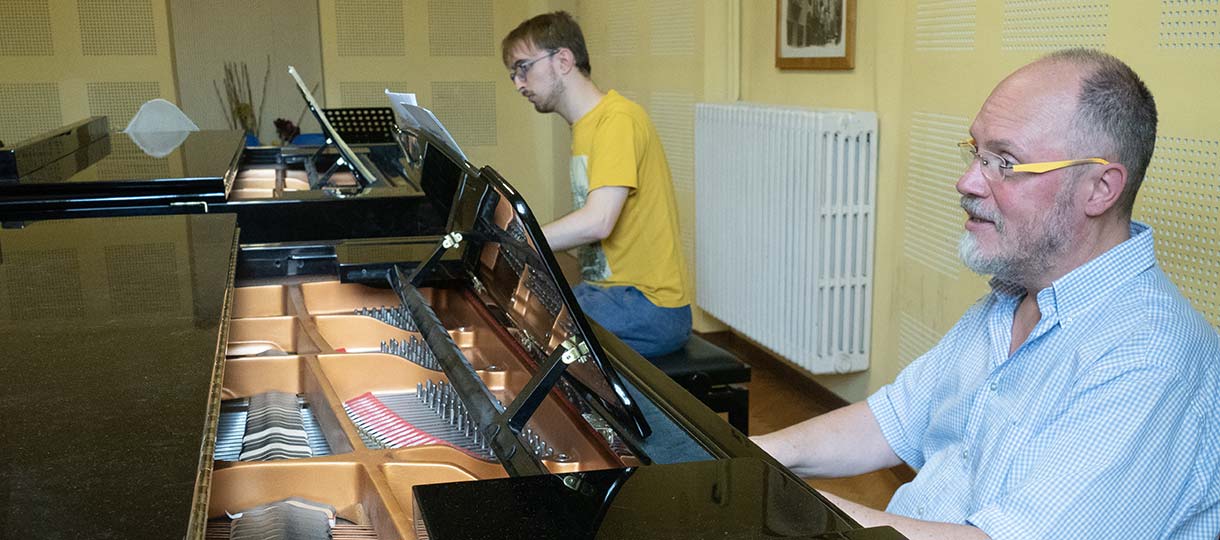
A multi-award-winning pianist with a meteoric career, Filippo Gamba has performed with prestigious orchestras such as the Berliner Sinfoniker, the Wiener Kammerorchester, the Staatskapelle Weimar, the Camerata Academica Salzburg, the Tonhalle Orchestra Zurich and the City of Birmingham Symphony Orchestra, under conductors including Simon Rattle, James Conlon, Armin Jordan and Vladimir Ashkenazy. His rigorous and passionate style, combined with his cosmopolitan character and great maturity, make him a unique ‘philosopher of the piano’. He is an active chamber musician and has been a professor at the Musik-Akademie in Basel since 2005.
At the Accademia di Musica, Filippo Gamba teaches an advanced Light course in piano. We interviewed him in the context of our project, A Career in Music, to ask him what suggestions and practical advice he would give to our students, who are destined to become the future generation of professionals.
What were the key experiences that marked your development and training as a musician? At what time of your life did they take place? Why were they significant?
My development was profoundly shaped by my encounters with three pivotal teachers, Renzo Bonizzato, Maria Tipo and Homero Francesch. For different reasons, I was able to draw knowledge and inspiration from each of them. My journey of almost twenty years spent in the company of these masters has given me a musical and artistic perspective that has made me an independent musician – a goal I now strive to achieve with my own students, now that I find myself on the other side.
Can you describe one or two turning points in your career? What impact did they have on your career? Why were they important?
Winning the Geza Anda Competition was undoubtedly the catalyst for my professional career, but it took a great deal of determination to get there. There were times when I thought about giving up the piano to pursue something else, but my perseverance and the support of my teachers enabled me to reach a crucial milestone, after which I was able to continue on the path I had set out on.
Often our mistakes teach us important lessons. If you could go back in time in your career what would you do differently?
At a certain point in my career, there were occasions when I should have been more diplomatic or ‘politically astute’. My uncompromising nature (seen by others as a limitation, but which I regard as a strength) may well have been seen as an obstacle. Although I look back with a touch of regret, today I feel I can enjoy the freedom I have earned over time, which I wouldn’t swap for anything else.
Along a musician’s career path there are always many important decisions to be made and these often depend on and result from the opportunities that are offered to them. What helped you to stay focused and not to lose sight of your goals?
First and foremost, the example set by my teachers; then the deep and honest ‘feeling’ for the inner world that composers express through their music – intimate confessions that the performer has the privilege of perceiving and subsequently sharing.
Apart from studying with great passion and dedication, what advice would you give to young musicians who are starting out on a career in music?
The current generation of young musicians is commendable for its tenacity. They are talented musicians who deserve a platform, one that is sometimes denied them in favour of established concert-hall stars. We certainly need to engage with mature and authoritative musicians, but I see a disparity in the recognition and support given to their talent. I would suggest what I mentioned earlier, namely a strong managerial ability to promote one’s own worth, done with grace and without ostentation, yet decisively and with conviction. Time is on their side.

