Maestro Emanuele Arciuli, internationally one of the best-known and most acclaimed interpreters of twentieth and twenty-first century music, has been teaching at the Accademia for eight years. In addition to holding his own Advanced Course, he is also one of the teachers in the post-graduate, 3rd university level Specialisation Course, together with Ralph Van Raat, Nicolas Hodges and Maki Namekawa.
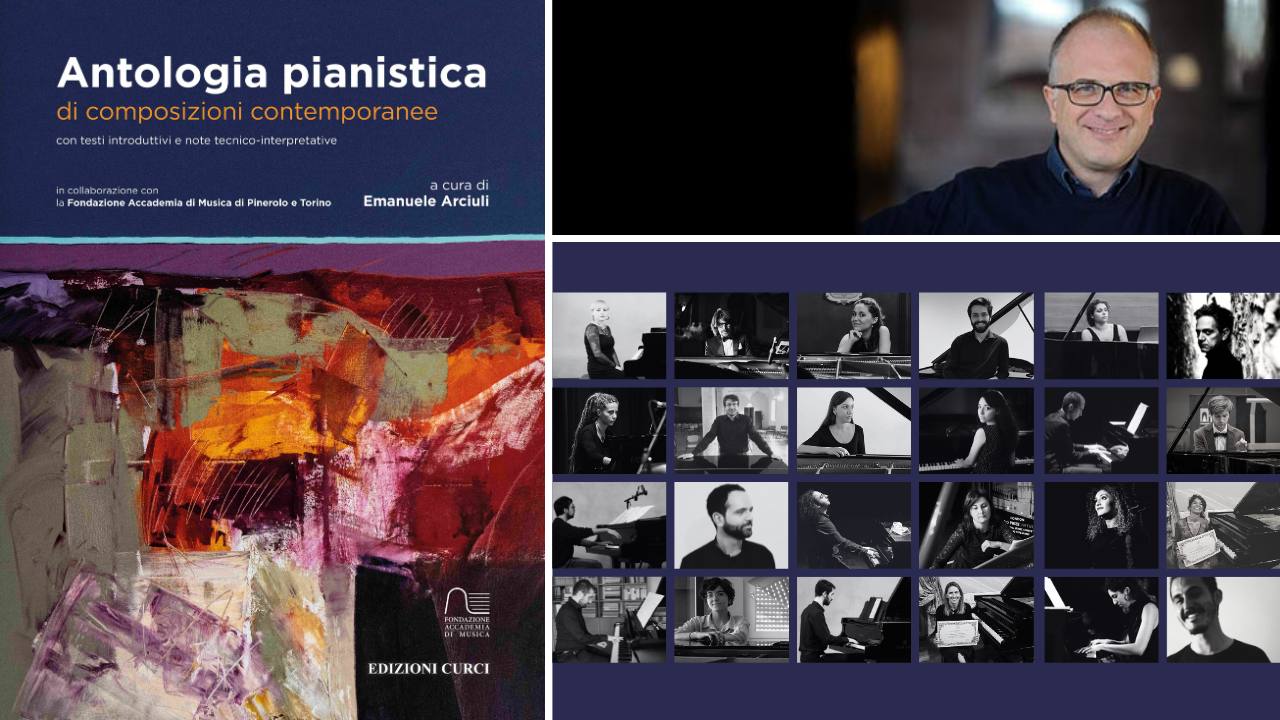
Always actively committed to promoting modern music, he often involves his students in special projects. Last year it was the Complete Works of Marga Richter; this year it was a collaboration with the Antologia pianistica di composizioni contemporanee – Anthology of Contemporary Compositions for Piano published by Edizioni Curci, a first anthology of pieces at different levels of difficulty. We interviewed Maestro Arciuli to ask him to tell us more…
An anthology of contemporary compositions for piano by Emanuele Arciuli in collaboration with the students of the Accademia: READ THE INTERVIEW
A musician approaching contemporary music for piano for the first time may feel disoriented, given the vastness of the repertoire, especially when they are looking for scores to play …
In actual fact, it is a bit like that, because although there is an endless production of modern music, in the academic world there is limited knowledge of this repertoire, as well as a deep distrust of the music of today. And it is students who are negatively impacted by this; sometimes they literally do not know where to start. Of course, curiosity is the driving force, and teachers should stimulate this. Also, it is not always easy to find music, even though now many composers can be contacted directly, which makes things easier. For this I must once again thank Laura Moro and the wonderful staff at Curci Edizioni, and I am glad that Laura Richaud, with the Fondazione Accademia di Musica, has joined the project, which I feel is very much my own. If this project has become a reality, it is all thanks to them.
Maestro, could you tell us how and why you involved your students at the Accademia?
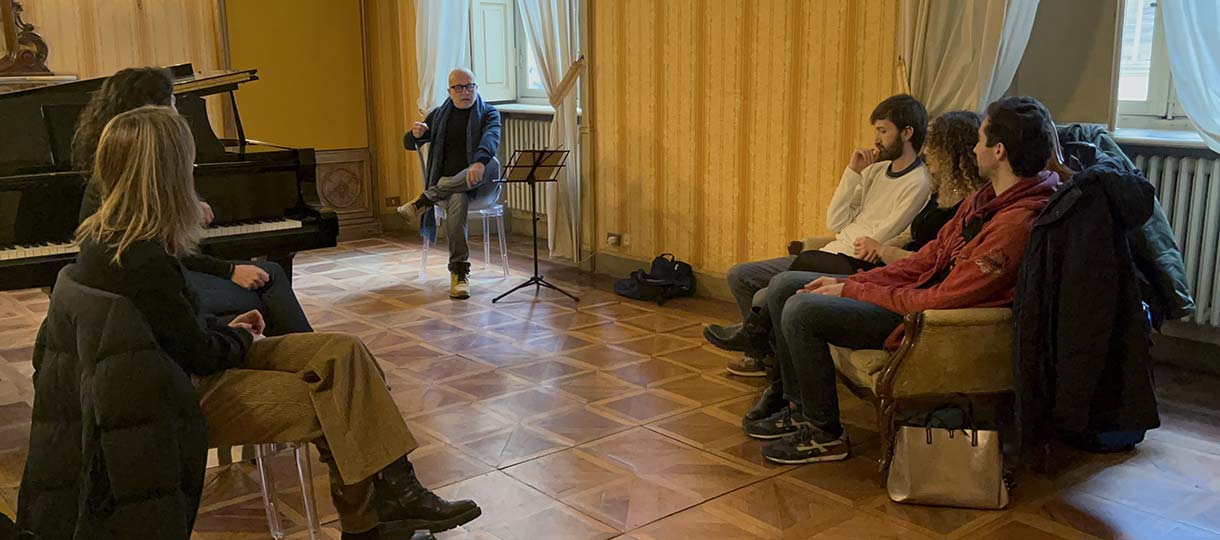
My idea was to involve one student for each piece, which would also give them the opportunity to gravitate towards the composer (among those I had selected) for whom they felt the greatest affinity. The reason for the involvement is twofold. Firstly, I have always based my courses at the Accademia on involving my students in shared projects, and I believe that creating together materials for teaching contemporary music was the ideal way to develop a project concretely. But above all, since the collection is essentially aimed at students, I wanted to analyse this music together with young pianists, in order to understand what were the biggest challenges they found, and thus provide practical guidelines for future interpreters of these compositions.
So I asked a number of students to lend me a hand: these were Roberta Pandolfi, Emanuele Stracchi, Flavia Salemme, Simone Librale, Lucija Majstorovic, Marcello Calabrò, Sonia Candellone, Francesco Zago, Mattia Cicciarella, Luca Giarritta, Michele Guerrieri, Gaston Polle Ansaldi, Beatrice Mariella Macchia, Daniele Fasani, Valentina Gentile, Maristella Diquattro, Bruna Di Virgilio, Carlo Angione, Christina Katidou, Emanuele Scaramuzza, Melania Bertolo, Alessandra Di Gennaro,Biagio Finamore and Sara Moro.
In fact, the work of analysis was shared and was a positive learning experience, both for the students and for me, an experience that, as I said before, enabled me to gain insight into the difficulties and problems that Conservatory students might face when reading these scores. Essentially, it is a new, and I hope helpful, initiative, which we hope will attract the attention and arouse the interest of young students and their teachers. I also hope that this will be only the first volume in a series, because there are so many other extremely interesting composers whom I would like to include in the future.
What were the greatest problems and difficulties you encountered in approaching contemporary music?
Above all, the prejudice that contemporary music is considered as a completely separate entity, a sort of enclave you should stay well away from. And also the idea that the piano and musical skills needed to perform and interpret it are different and less “important” than those required for the traditional repertoire (clearly an idiotic notion), which runs the risk of severely marginalising the music of today. This is paradoxical, because it is as if we were censoring the present.
Why is it important to explore contemporary music?
Because it allows young musicians to complete their experience of music culture, because it includes some wonderful masterpieces, because it avoids the risk that “classical” music is considered merely as a collection of museum pieces.
One last question. if you were in your first year at the Conservatory, which piece would you start with? And if you were about to graduate?
It depends on the student’s talent. I find that works by Gubaidulina, Lachenmann, Gilbert, Obermüller and Larcher are excellent for beginners. But there are also some excellent examples among the Italian pieces in our anthology. As for the composers that I would suggest for a more advanced student, there are thousands upon thousands to choose from. Études australes by Ivan Fedele is an important piece, but so are Bolcom’s Études, many wonderful pieces by Takemitsu, and of course my beloved Rzewski and Crumb. However, I repeat, the musical quality of the pieces included in the anthology is very high: they are all pieces intended for concert performance, not simply to be used for teaching. When music is good, there is always something to be learnt from it.
Students who took part in the project share their experience: READ THEIR COMMENTS
“I would like to thank all those who involved me in this project and for the trust they placed in me. I would like to express my very sincere gratitude to Maestro Emanuele Arciuli. We have had a working relationship for many years, a relationship which has inevitably been conducted “long-distance” for some time, so I was very glad and proud to see that he had still thought of me for this project. I had to take on the role of editor and work on the Invocations of the Aetherwind composed by Richard Cameron-Wolfe, a collection of contemporary miniatures for solo piano: a wonderful experience, which I found stimulating and from which I certainly learnt a lot. My contribution was “respectfully” minimal, almost marginal; however, I was able to carefully study the “programme” intrinsic to the pieces and to observe how magical and esoteric elements can translate into fascinating sounds produced by the piano. It is incredible to think that this process sometimes results from the piano as a physical object: the materials it is made from, its natural resonances. This is a demonstration of a certain resilient freedom in the artists of today, which is so far from the attitude towards the giants of classical tradition. Here, nothing is predictable or can be replicated to perfection, in contrast with what occurs in the unchanging worlds of the works of Chopin, Brahms or Rachmaninov.” Biagio Finamore
“It was an extremely stimulating experience to be part of Emanuele Arciuli’s project to create the anthology published by Edizioni Curci. Writing the introductory notes for Scat-Beguine by Antonioni and being able to work closely with the composer took me straight into the heart of writing for contemporary piano, not only on a technical level, but, above all, on a communicative level: translating into words a language that is so rich in contrasts, rhythms and sound worlds was fascinating. To be able to contribute to the understanding of the piece, while exchanging ideas directly with the composer, made me feel that I was an active part of a shared creative process. I am a composer and a performer, so this seemed to me to be a pathway that opened up my capacity to listen, heightened my curiosity and, above all, forced me always to seek out the most authentic words. I am grateful to have been part of this project.” Emanuele Stracchi
“I am very happy to have contributed to this publishing project curated by Emanuele Arciuli, who is such a brilliant pianist, instrument teacher and music educator, as well as being one of my teachers on the postgraduate specialisation course at the Accademia di Musica. At his invitation and following his advice, I was delighted to work on “Apocrifo” composed by Claudio Ambrosini. It is a wonderful thing that the Accademia involves its former students in important projects, as I was involved, in 2023, in the performance of the complete Études by György Ligeti. I am truly grateful to Maestro Arciuli for the trust he has continued to place in me. I hope you can forgive my vanity in presuming that this trust is the proof that I left positive memories behind me in Pinerolo, during my many years of involvement with this school, to which I am forever grateful” Roberta Pandolfi
“Was delighted to accept Maestro Arciuli’s request to be involved. In my specific case, given the particular nature of the piece I was assigned, I asked myself what the most effective study methods would be in order to best meet the composer’s requirements, and how I could reproduce them in the simplest and most functional way possible. I therefore hope that my introductory notes will be of help to those who, perhaps for the first time, are about to study an “indefinite” piece. Finally, I think that an anthology like this could be an excellent starting point for anyone just beginning to get to know and to perform the contemporary repertoire, which is presented here in many facets of its particular language.” Gaston Polle Ansaldi
“When we think of an anthology for piano, we often think of the music of tradition, now somewhat outdated. However, looking through the Anthology of Contemporary Music for Piano created by Maestro Arciuli, wider horizons open up in the mind, towards something really new. A real “breath of fresh air”, consisting of new, modern music that is accessible to all musicians (whether they are taking courses in piano or already have established careers). The various art forms emerging at the present time continually surprise us, but classical music is still often perceived as exclusively rooted in history: this anthology creates a tangible bridge to the contemporary piano repertoire. I am deeply grateful to Maestro Emanuele Arciuli for his forward thinking, for including me in this outstanding group of students and former students, and for his genuine desire to contribute to a real paradigm shift in music. The anthology is an invitation to read, study and experience these pieces with curiosity and an open mind.” Sara Moro
-
- CONTEMPORY PIANO: 3rd UNIVERSITY LEVEL >>
- CONTEMPORY PIANO: ADVANCED COURSE >>
- A CAREER IN MUSIC: READ THE INTERVIEW WITH EMANUELE ARCIULI >>
- MARGA RICHTER PROJECT: SEE MORE >>

